
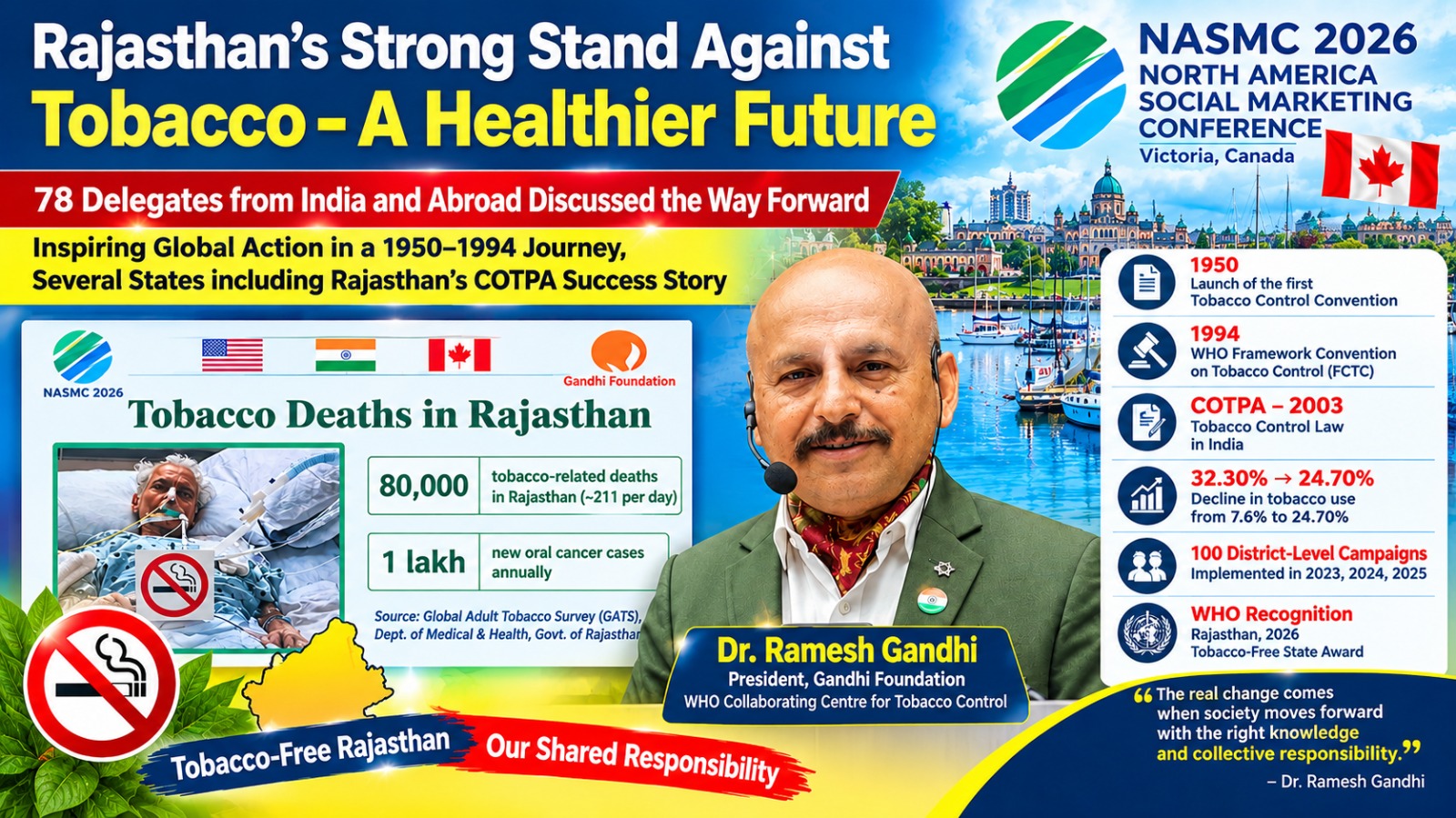
Rajasthan’s Tobacco-Free Model Resonates in Canada, Drawing Global Recognition
Rajasthan’s Initiative Emerges as India’s Only Case Study Among 78 International Research Papers
A Campaign That Began in 1950 Has Come a Long Way—from a 1994 Public Interest Litigation to Laying the Foundation for India’s COTPA Law
Jaipur/Victoria (Canada), dusrikhabar.com. The call to quit tobacco is often reduced to statistics and awareness campaigns, but Rajasthan’s story goes much deeper. After 76 years of sustained government and community-led efforts against tobacco, Rajasthan’s model has now gained recognition on an international platform. At the North America Social Marketing Conference (NASMC-2026) held in Victoria, Canada, Rajasthan’s tobacco-control model was presented as India’s only case study.
Dr. Ramesh Gandhi, President of the Gandhi Foundation and a member of the WHO Civil Society Commission, presented Rajasthan’s long journey through an online presentation at the conference. Experts from several countries, including the United States, Canada, the United Kingdom, Mexico, Australia, South Africa and India, participated in the event. The recognition received by Rajasthan’s initiative among 78 global research papers is being regarded as an important achievement for the state’s public-health and social-awareness efforts.
read also:कैसा रहेगा आपका आज, क्या कहता है भाग्यांक? 6अक्टूबर, मंगलवार, 2026
A Step Taken in 1950 That Paved the Way for the Future
Rajasthan’s journey in tobacco control is not a recent one. Just a few years after Independence, in 1950, the state implemented the ‘Juvenile Smoking Prevention Act’. At a time when tobacco control was still largely outside the mainstream public-health agenda, the initiative marked an important step.
Over the years, social organizations and health-sector groups also helped carry the campaign forward. In 1994, the Rajasthan-based Indian Asthma Care Society filed a Public Interest Litigation (PIL) in the High Court. This initiative subsequently came to be regarded as an important foundation in the development of comprehensive tobacco-control legislation in India, leading eventually to the COTPA 2003 law.
In this way, an effort that began in Rajasthan went beyond the boundaries of the state and contributed to a longer process that influenced India’s tobacco-control policy framework.
read also:राजस्थान यूथ कांग्रेस चुनाव: अभिषेक चौधरी सबसे आगे, जिलों में भी नई युवा टीम को जिम्मेदारी
Tobacco Use Declined from 32.30% to 24.70%
The real success of any public-health campaign can be measured by the difference it makes in people’s lives. In Rajasthan’s case, the figures provide an indication of this change.
According to the Global Adult Tobacco Survey-2 (GATS-2), tobacco use in the state declined from 32.30% to 24.70%, representing an absolute reduction of 7.60 percentage points.
The change was not driven by government efforts alone. Social organizations also played an important role in awareness and tobacco-control initiatives. Gayatri Parivar, Seva Mandir, Rajasthan Cancer Foundation, SRKPS, Gandhi Foundation, Rajasthan Voluntary Health Association, CUTS and Prayas, among others, contributed to the campaign.
Campaign Focused on the Younger Generation
Special attention was given to young people in efforts to prevent tobacco use. Rajasthan’s 100-day ‘Tobacco-Free Youth Campaign 2022’ was subsequently adopted by the Central Government.
The campaign was then expanded nationally in three phases during 2023, 2024 and 2025. It demonstrates how a social-health model developed at the state level can become part of a nationwide campaign.
read also:भारत-US ट्रेड डील में रोड़ा? सीतारमण क्यों बोलीं- आगे बढ़ना बहुत मुश्किल
Four WHO Honors, and First Place in the South-East Asia Region in 2026
Rajasthan’s tobacco-control efforts have also received international recognition. The World Health Organization (WHO) has honored Rajasthan four times.
In 2026, Rajasthan’s Health Department was awarded first place in the WHO South-East Asia Region. The recognition is being viewed as international acknowledgment of the strategies adopted by the state for tobacco control and the role of community participation.
An Achievement That Goes Beyond Statistics
The greatest strength of Rajasthan’s tobacco-free campaign has not been limited to laws or government orders. Community participation has been a key element of the effort. When health departments, social organizations, voluntary groups and citizens come together to address a social problem, the resulting change can become more sustainable.
The presentation of Rajasthan’s story at the conference in Canada highlights how local experiences in public-health campaigns can also evolve into models of interest for the wider world.
Dr. Gandhi’s Message
Summing up the experience at the conclusion of his presentation, Dr. Ramesh Gandhi said that when the right strategy is combined with community participation, even major social challenges can be addressed through meaningful and effective change.
